What NVIDIA’s New Jetson T3000 and T2000 Mean for Physical AI
Physical AI systems are moving from development platforms into production deployments. Humanoid robots, autonomous mobile robots, manipulators, smart infrastructure, and industrial systems all require sufficient AI performance, but peak compute alone does not determine system capability. Production designs also need to guarantee deterministic sensor latency, manageable power consumption, and a hardware architecture that can scale across multiple product configurations and can be cost optimized.
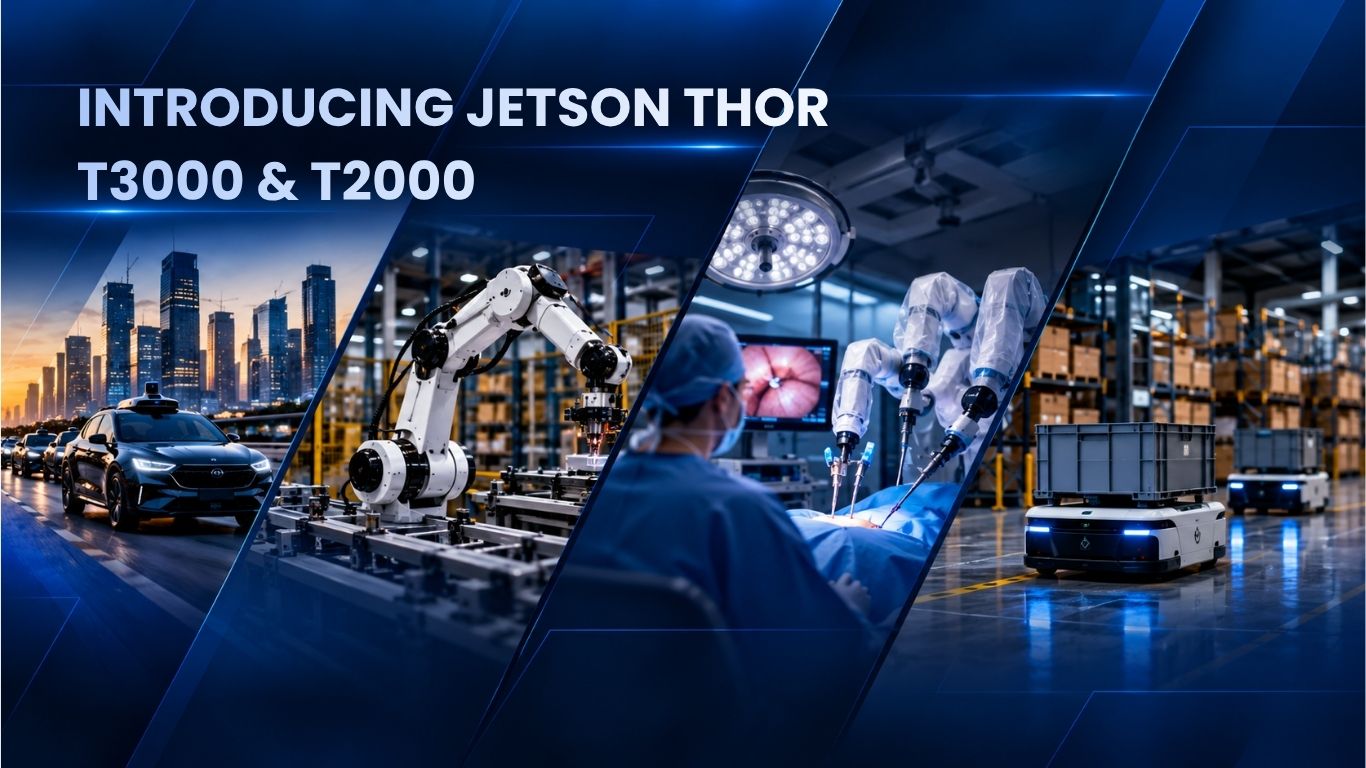
NVIDIA is addressing the compute side of that requirement by expanding the NVIDIA Jetson Thor family with the Jetson T3000 and T2000. Both modules use the same NVIDIA Blackwell architecture and Jetson software environment as the flagship T5000, but target smaller and lower-power systems. NVIDIA Holoscan Sensor Bridge addresses the other side of the architecture by transporting sensor data over Ethernet with PTP synchronization and a low-latency data path to GPU memory. Together, these technologies provide a practical way to scale physical AI systems without redesigning the complete compute and sensor stack for each performance tier.
Tauro’s implementation: one sensor architecture across Thor platforms
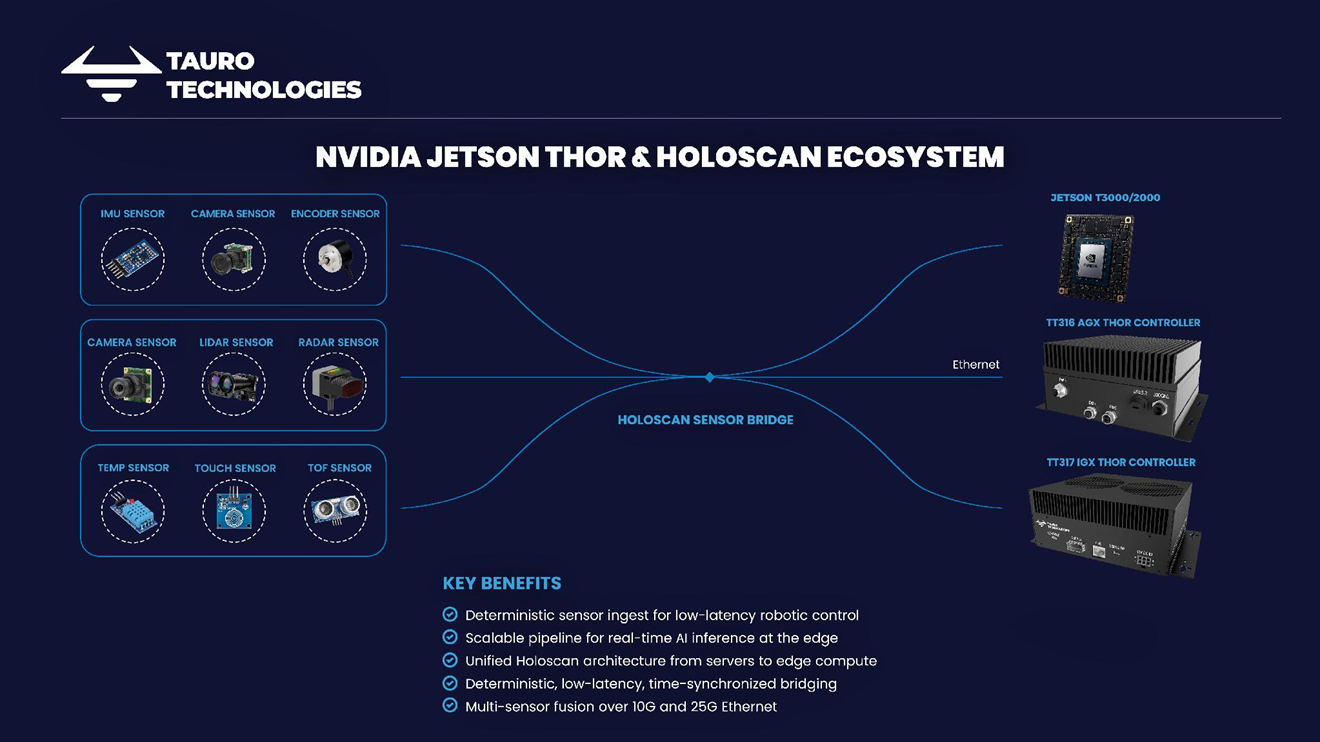
Tauro Technologies provides the production hardware layer for this architecture. Developed in close collaboration with NVIDIA and Lattice Semiconductor, our DA322 Holoscan MIPI Adapter implements the Holoscan Sensor Bridge technology in a compact production module. DA322 includes four MIPI CSI-2 inputs, 10GbE over SFP+, a Lattice CertusPro-NX FPGA with RDMA and GPUDirect support, IEEE 1588 PTP synchronization, and a compact footprint of 75mm x 45mm.
The DA322 is part of a broader Tauro platform and sensor ecosystem:
- TT317 IGX Thor platform – an enterprise-class edge AI platform for industrial, medical, and high-performance physical AI deployments.
- TT310, TT314, TT315, and TT316 – rugged and industrial Jetson Thor platforms for outdoor robotics, autonomous systems, transportation, and high-throughput edge AI applications.
- DA326 Holoscan GMSL Adapter – connects GMSL2 and GMSL3 cameras to NVIDIA platforms using Holoscan Sensor Bridge.
- DA328 Holoscan 3G-SDI Adapter – connects SDI video sources to NVIDIA platforms using Holoscan Sensor Bridge.
Tauro is also preparing platform support for the NVIDIA Jetson T3000 and T2000. Initial application and sensor-pipeline evaluation can begin with T3000 emulation on the NVIDIA Jetson AGX Thor Developer Kit.
Each product shares the same FPGA baseline and software stack, making adding a new sensor type or stepping between Thor tiers with no design change which dramatically reduces NRE and shortens the path to system qualification. The same architecture serves AGVs and humanoid robotics, industrial automation, transportation, automotive, and medical systems: production-qualified, OEM-ready, and USA-manufactured.
A scalable Jetson Thor architecture
The main architectural advantage is consistency across the NVIDIA Jetson Thor family. T2000, T3000, T4000 and T5000 share the same NVIDIA Blackwell GPU architecture and the NVIDIA JetPack software stack. This allows engineering teams to evaluate workloads on one Thor platform and move between module tiers with substantially less software rework than a change to a different compute architecture.
NVIDIA Jetson T3000 targets mainstream robotics and Edge AI that do not require the full memory capacity or power envelope of T5000. Preliminary specifications include 865 FP4 TFLOPS, an 8-core Arm Neoverse CPU operating at 2.6 GHz, 32 GB of LPDDR5X memory, x1 25GbE Ethernet Interface, and a 70 W module power target. NVIDIA positions T3000 at similar inference performance of the T5000 for selected LLM, VLM, VLA, and world-model workloads, while using roughly half the module power and a smaller form factor.
NVIDIA Jetson T2000 provides a lower-power entry point to the Thor architecture. It combines 400 FP4 TFLOPS, a 6-core Arm Neoverse CPU at 2.6 GHz, 16 GB of LPDDR5X memory, and a 40W power target. This configuration is intended for applications such as autonomous mobile robots, manipulators, visual AI agents, and compact edge systems that need Blackwell-class inference capability within a constrained thermal and power budget.
Because the modules use the same software foundation, applications can be developed with JetPack and NVIDIA’s physical AI software ecosystem, including NVIDIA’s open models such as Isaac GR00T, Nemotron, and Cosmos. The common architecture does not eliminate platform validation, thermal design, or I/O integration, but it reduces the amount of application-level rework required when moving between Thor compute tiers. NVIDIA is also bringing Cosmos 3 Edge , first full omnimodel for physical AI to Jetson Thor for real-time multi-view and livestream understanding and custom robot policy deployment at the edge.
Jetson Thor modules at a glance
Preliminary specifications. Subject to change.
| Jetson T2000 | Jetson T3000 | Jetson T4000 | Jetson T5000 | |
| AI Performance (FP4) | 400 TFLOPS | 865 TFLOPS | 2,000 TFLOPS | 2,000 TFLOPS |
| GPU (Blackwell CUDA cores) | 1024 | 1536 | 1536 | 2560 |
| CPU (Arm Neoverse) | 6-core @ 2.6 GHz | 8-core @ 2.6 GHz | 12-core @ 2.6 GHz | 14-core @ 2.6 GHz |
| Memory | 16 GB LPDDR5X 137 GB/s | 32 GB LPDDR5X 273 GB/s | 64 GB LPDDR5X 273 GB/s | 128 GB LPDDR5X 273 GB/s |
| Power | 40 W | 70 W | 70 W | 140 W |
Scalable sensor platform as key part of the architecture
A physical AI system is limited by how reliably it can acquire and process sensor data. Cameras, LiDAR, Radar, IMUs, encoders, and other sensors must reach the compute platform with predictable latency and a common time base. As sensor count and bandwidth increase, the sensor ingest architecture can become a system bottleneck even when the GPU has sufficient inference performance.
NVIDIA Holoscan Sensor Bridge provides an alternative architecture. An FPGA-based sensor endpoint receives native sensor interfaces such as MIPI CSI-2, I2C, SPI, GPIO, and related protocols, packetizes the data for Ethernet transport, and delivers it to the host through the Holoscan software stack. With RDMA and GPUDirect, Holoscan Sensor Bridge allows delivering sensor payloads directly into GPU-accessible memory. NVIDIA-published benchmarks report signal-processing latency below 1 ms, approximately 1% CPU utilization for accelerated ingest, up to 10x lower latency than selected traditional pipelines, and significantly lower driver-development effort. Actual results depend on the sensor, network configuration, host platform, and processing pipeline.
Why HSB matters when right-sizing compute
The addition of T3000 and T2000 provides the ability to select a compute module based on the actual inference, memory, power, and thermal requirements of the application. That approach is effective only when sensor ingest does not consume a disproportionate share of the CPU and memory bandwidth. By moving sensor interface handling and packetization to the FPGA endpoint, and by using an accelerated host path, HSB reduces the amount of compute spent on sensor transport and buffer management. The recovered resources remain available for perception, planning, reasoning, and control workloads.
The same sensor architecture can also be reused across NVIDIA AGX, IGX Orin, Jetson Thor, IGX Thor, and x86 systems with NVIDIA GPUs. The host integration still requires platform-specific validation, but the sensor endpoint, Ethernet transport, synchronization method, and application-facing data path remain consistent. On NVIDIA Jetson Thor and IGX Thor, the accelerated networking path is integrated into the platform. On Jetson AGX Orin, GPUDirect RDMA can be enabled through a compatible external NVIDIA ConnectX NIC. This common architecture makes it easier to prototype on one platform and deploy on another without redesigning the sensor interface.
Do more with less: memory optimization and agent skills
Hardware selection and software optimization must be considered together. Jetson systems use unified memory, so the operating system, inference runtime, models, pre-processing, post-processing, and sensor buffers all compete for the same memory pool. NVIDIA’s optimization guidance includes headless operating-system configurations, efficient runtimes such as llama.cpp and TensorRT Edge-LLM, and lower-precision formats including NVFP4 and INT4. Depending on the starting configuration, these changes can recover 10 GB or more of memory and allow larger or additional models to run on the same module.
The Reachy Mini Jetson Assistant is one example of this approach. A local voice-and-vision agent combines a vision-language model, speech-to-text, text-to-speech, face tracking, and robot control on an 8 GB Jetson platform. NVIDIA’s Jetson agent skills are intended to inspect memory use, identify bottlenecks, and validate optimizations on the target hardware. Combined with low-overhead sensor ingest, these methods allow engineering teams to select a smaller Thor module without reducing application capability.
Start designing soon – emulation available by end of the month
The NVIDIA Jetson AGX Thor Developer Kit can emulate the T3000 and T2000 configurations while running the JetPack software stack, supported models, and Jetson agent skills. T3000 emulation is planned to be available by end of this onth , with T2000 emulation following later. This allows teams to characterize model performance, memory use, sensor bandwidth, and application latency before production modules are available in Q1 2027.
The takeaway
NVIDIA Jetson T3000 and T2000 extend the Blackwell-based Thor architecture into lower-power and lower-memory system configurations. NVIDIA Holoscan Sensor Bridge provides a common sensor-ingest architecture that can scale with those compute tiers by reducing host overhead, supporting PTP synchronization, and enabling accelerated data delivery to GPU memory.
For engineering teams, the practical benefit is a more modular system architecture: select the Thor module based on the workload, then reuse the same sensor endpoint and transport architecture across multiple deployment platforms. Tauro provides the rugged compute platforms and production-ready HSB adapters required to implement that architecture.
Design the Edge. Deliver the Future.