
COM-HPC: New Standard Empowers Embedded Systems
The embedded computing industry has recently (in the early 2021) approved COM-HPC (short for computer-on-module (COM) – high performance compute (HPC)) as the next-generation standard for modular system designs. It promises to boost the power and capabilities of edge computing and introduce a selection of new applications for COM-HPC modules.
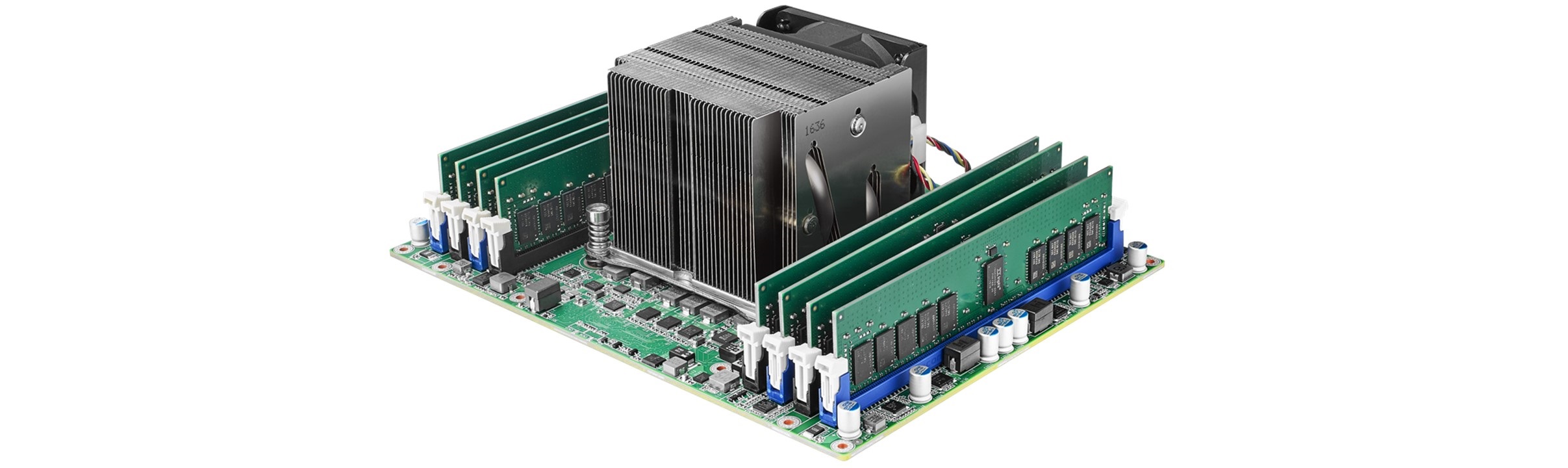
COM-HPC is very new to the market and rather complex when you go into details, which results in general lack of understanding of this standard, its advantages compared to COM Express (which is the most common computer-on-module form factor today), and potential new opportunities the introduction of COM-HPC brings us for embedded product development and rapid prototyping. COM-HPC leverages on the large eco-system of COM Express module manufactures such as the Advantech module pictured above. Tauro Technologies implements these modules into customer specific carrier boards saving cost and enables clients to bring their products to market faster.
What is COM-HPC (Computer-On-Module High Performance Compute)?
COM-HPC is a new computing standard that applies to high performance (HPC) computers-on-module (COMs) in embedded computers and edge servers. Developed and approved by the PCI Industrial Computer Manufacturers Group (PICMG), which is a consortium of over 600 companies who collaboratively develop open specifications for high performance telecom and industrial computing applications, COM-HPC was introduced as a way to better address the need for high I/O and computer performance in embedded computers.
- What is high-performance computing (HPC)?
High performance computing (HPC) is the practice of processing data and performing complex calculations at high speeds by aggregating computing power to provide higher performance. HPC systems are used by large companies across industries, in areas such as manufacturing and industrial automation, aerospace & military, oil & gas, life sciences, information technology, etc.
- How does COM-HPC work (in Modular Embedded System Architecture)?
COM-HPC modules include core CPU with memory and rich set of I/Os, such as USB (up to Gen 4), PCI Express (up to Gen. 5), Ethernet (up to 25 Gbits/s per lane) and audio (MIPI SoundWire, I2S, DMIC). All I/O signals, coming through a COM-HPC module, are mapped to two high density, high speed and low profile connectors on the bottom side of the module. COM-HPC modules are plugged into a carrier board customized to fit a specific application.
- Will COM-HPC replace COM Express?
One of common misconceptions about the COM-HPC standard is that it is introduced as a replacement to the previous COM Express specification. In reality, COM-HPC builds on top of COM Express specification, extending the Computer-On-Module concept to a full featured Server-On-Module. COM-HPC addresses the need for more interfaces than the 440 pins COM Express defines and extends the maximum level of performance the connector defined in the COM Express standard can handle.
- What types of COM-HPC are there?
There are two different pinouts defined in the COM-HPC specification: COM-HPC Server (meant for embedded server-on-modules) and COM-HPC Client (meant for more traditional high-performance embedded systems). The specification also defines five module sizes, 3 for the Client Type and 2 for the Server Type.

Benefits of COM-HPC
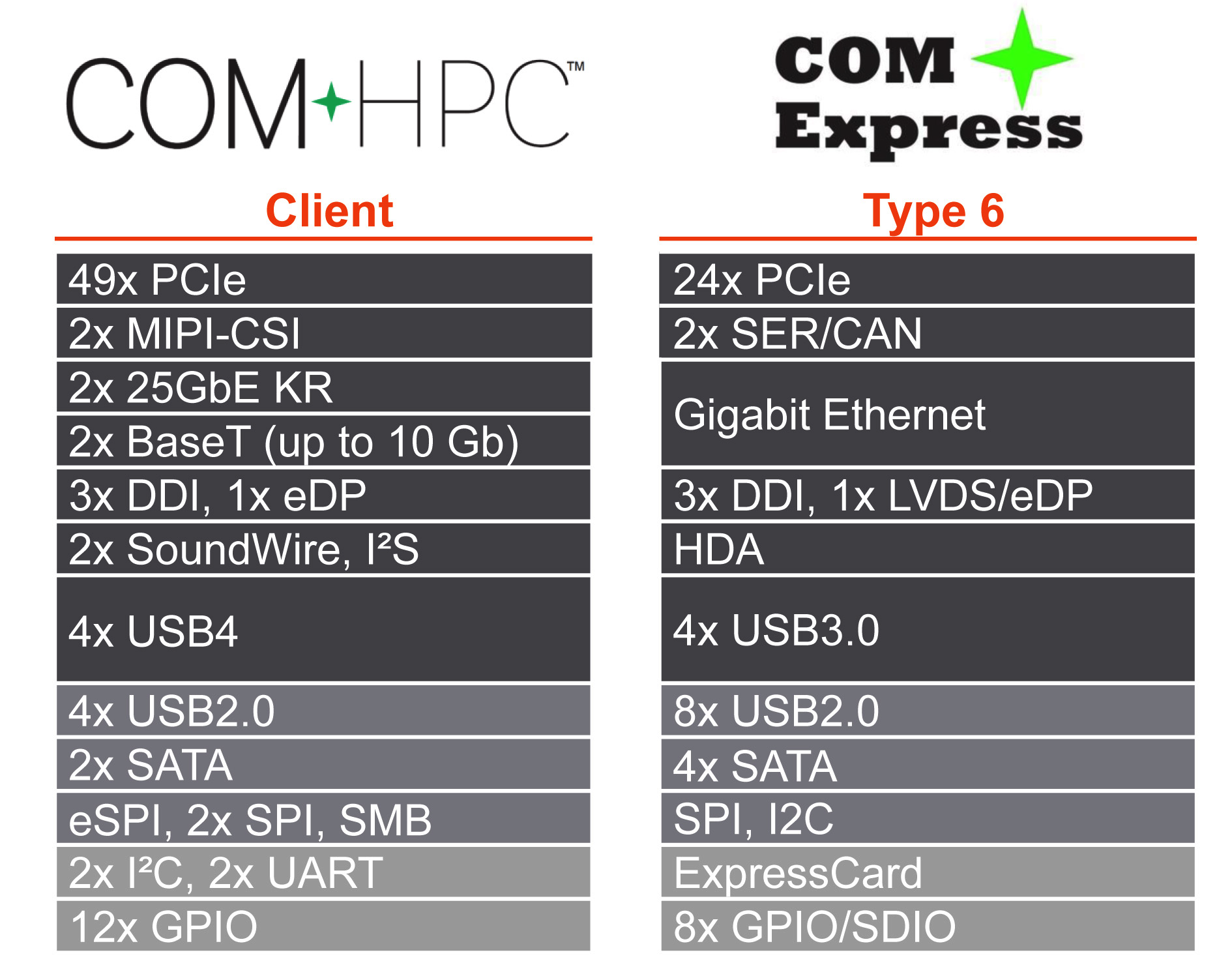
COM-HPC standard has a number of major strengths and differences compared to COM Express, and provides technical specifications that address many of its performance-related problems. Let’s talk about some of the most notable benefits the adoption of COM-HPC can deliver. See Figure 2 below for a comparison table.
- Easy to upgrade and faster time to market.
COM-HPC addresses a higher compute density than was possible with COM Express. Systems that were previously customized to meet application-specific requirements are commonly facing obsolescence and are expensive to upgrade to follow the rapid evolution of processor capabilities. COM-HPC solves this problem by enabling applications to upgrade by changing the COM-HPC modules rather than the entire design, reducing development costs and accelerating product launches. Utilizing COM-HPC also leads to faster time to market (compared to custom HPC systems) and lower cost of ownership by leveraging proven processor designs instead of relying on custom processor designs.
- Higher memory performance.
COM-HPC provides more memory performance to address the need for high memory bandwidth and size requirements in micro, edge and fog servers. COM-HPC server-on-modules can host up to 8 DIMM sockets for as much as 1.0 terabyte of RAM enabling advanced edge AI computing, real-time data processing, and high-performance embedded analytics.
- Increased I/O performance.
COM-HPC can provide increased I/O performance to as fast as 256 Gbytes/sec. It’s Server defines 8x 25 GbE connectivity, as well as 65 PCIe lanes for PCI Express Gen 4.0 and Gen 5.0. This allows COM-HPC Server to offer great levels of connectivity. Another 2x 40 Gigabit/s can be added via the two USB 4.0 interfaces.
COM-HPC Server modules also support four additional USB 2.0 interfaces, 2x native SATA, eSPI, 2xSPI, SMB, 2x I2C, 2xUART and 12 GPIOs. An additional 10 Gb Ethernet port serves as a dedicated communication channel for remote and out-of-band management.
- More pins and interfaces.
The number of pins in the COM-HPC standard has almost doubled compared to COM Express, from 440 to 800 pins. The increased number of connections that can be made with a single module allow COM-HPC modules to enable more features in a smaller form factor supporting advanced embedded systems design and modular computing architectures with enhanced I/O density.
- Enhanced server-board management.
A dedicated system management interface, introduced by COM-HPC, empowers remote edge server module management and provides extended communication functions . It also adds flexibility to configurations by enabling the use of thin slot cards to reduce the size of the system.
- More space for processing units.
Finally, the abundance of space COM-HPC modules provide for processors and other computing units is another considerable advantage of this standard compared to COM Express. COM-HPC Server offers module footprints of 200 mm x 160 mm (Size E), or 160 mm x 160 mm (Size D), while COM-HPC Client offers module footprints of 95 × 120 mm (Size A), 120 × 120 mm (Size B), and 160 × 120 mm (Size C).
Summary (COM-HPC for Next-Generation Embedded Systems)
The COM-HPC specification enables extremely high I/O and computer performance levels in embedded systems and edge computing platforms. The extended capabilities of this standard open new opportunities in customizing COM-HPC modules plugged into a carrier or baseboard to both create new applications for them as well as modernizing current solutions to boost their performance level.
We at Tauro Technologies are excited about the introduction of the COM-HPC specification because it signifies the arrival of next-generation embedded systems, with new applications and projects on the way. As an embedded systems design firm with proven track record for on-time, on-budget, and high-quality product realization, we have the expertise to design, customize and implement application-specific carrier boards based on the COM-HPC standard, delivering custom-made solutions fitting your specific needs and requirements.
Interested to know more? Get in touch with us for details.